What’s the best smartwatch for women? Well, the best smartwatch for women must not only have basic features, but it should also make a fashion statement.
In pursuit of the perfect smartwatch to match the modern woman’s style, we have expertly hand-picked and reviewed the top 10 that you can buy this year.
Best Smartwatch for Women 2026 – Comparison Table
Before we delve into more details on what to look out for before buying any smartwatch, here is a sneak peek at our Top 10 Best Smartwatch for Women list:
| Top 10 Best Smartwatches for Women | |
|---|---|
| 1. Garmin vívomove HR Sport Hybrid Smartwatch - Rose Gold (Our top pick) | |
| 2. Withings Activité Pop (Our budget pick) | |
| 3. Samsung Gear S3 Classic Smartwatch | |
| 4. Apple Watch Series 3 38mm Smartwatch (For iPhone users only) | |
| 5. Fitbit Charge 2 | |
| 6. Fossil Q Wander Gen 2 Rose Gold-Tone Smartwatch FTW2112 | |
| 7. Fossil Gen 3 Q Venture Rose Goldtone Pave Smart Watch | |
| 8. Michael Kors Access Touchscreen Bradshaw Smartwatch | |
| 9. Michael Kors Access Women's MKT5022 - Sofie Connected | |
| 10. Kate Spade New York Women's Smartwatch KST2003 |
There are several benefits of owning a smartwatch. First and foremost, you can simply perform some tasks on your wrist and save yourself some time. This is way better than having to open your handbag to see a notification or respond. With a simple glance, you can make a quick decision and continue with your business as usual.
The things you can do with the health information you get are limitless. You will not need to be perturbed by certain health conditions since you are keeping track of your body.
As smartphone screens become larger, they no longer store power for an extended period. It will, therefore, be a relief to know that with a smartwatch, you do not have to use your phone so often, thus preserving its power for longer.
You will be able to handle things discreetly, especially if you are in public or at a formal event. Most people do not know phone etiquette, but with a smartwatch, this should be pretty easy. You can receive messages and respond even in a meeting without leaving the room.
So, now that you know what a smartwatch can do and how essential it is, it’s time to decide which one to buy among our top 10.
Reviews of the Best Smartwatches For Women in 2026
These are the best smartwatches for women in 2026:
1. Garmin vívomove HR Sport Hybrid – best smartwatch for women 2026
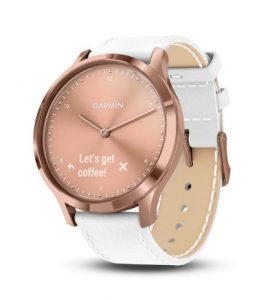
The Garmin vívomove HR Sport Hybrid Smartwatch an upgrade on all traditional watches. If you are the type of lady who loves being classy and trendy at the same time, then this is the smartwatch for you. It is our recommended best smartwatch for women.

A closer look at this watch might mislead you to think that it does not offer much other than a fashion statement. It actually does collect plenty of data, and this information is transferred to your phone.
In addition to controlling music on your wrist, you will always get your app notifications on your touchscreen, so that you never miss a thing. Another amazing feature is fitness tracking. This is made possible by heart rate monitoring capability as well as stress, steps, distance, and calories burned tracking.
Thanks to the Garmin Connect community, you won’t be alone in this adventure. You can share and plan your daily activities with others all for free. You can even connect to compete or challenge fellow users.
Main features
- Auto-sync and personalized step goal
- Steps and bar tracking
- Can work with both Android, and iOS
- Battery life up to 5 days
Click here to see its current price.
2. Withings Activité Pop
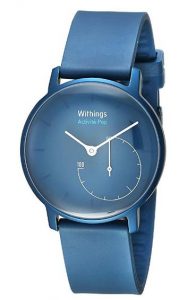
You want to be the standout lady at the party, and you will definitely need a smartwatch that can complement your efforts. The Withings Activité Pop is one such gadget. Silicon has never looked this good and felt so comfortable on the hands. First and foremost, no more power hassles. This watch is set to serve you for eight months straight. There is no need for daily charging.

The next best thing on the list is that this watch is water resistant to a very great extent. You see, you can actually swim all you want so long as you don’t exceed 50 meters deep. So, whether in the shower or at the pool, your watch is on watch. There is sleep tracking to ensure that you have healthy sleeping habits.
It doesn’t matter what kind of OS your smartphone has; Android or iOS, this watch delivers. You will, however, need to do daily syncing to store your data.
Main features
- Water resistant up to 50 meters
- No need for charging, extended life battery lasts up to 8 months
- Activity and run tracking
- Real-time coaching and sharing
- Sleeps automatically
- Weighs 1.3 ounces
Click here to see the current price of one of the best smartwatches for women.
3. Samsung Gear S3 Classic Smartwatch SM-R770NZSAXAR
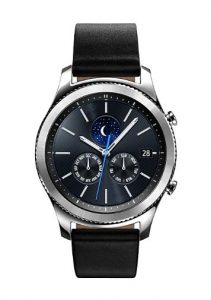
Samsung is a renowned manufacturer of electronics worldwide. From TVs, music systems, mobile phones, to smartwatches, the company has really set itself apart. Among their best products is the Samsung Gear S3. It is the latest model released in September 2017, succeeding the Gear S2.

There are two versions of Samsung Gear S3 – the Frontier and the Classic design. Given the more ‘rough’ appearance of the frontier, we consider the Classic version to be more suitable for ladies. In terms of appearance, it’s way better. Its steel bezel can be rotated to easily access apps and notifications. However, the features are the same so there’s no need to worry.
Apart from its better design to suit women with a sense of fashion, it offers military-grade performance. It is resistant to dust, water as well as the once-in-a-while drop. Also, when fully charged, it allows you to track your fitness levels and monitor your heart rate for up to 3 days.
The watch is also compatible with both iOS and Android, so you should get your notifications real-time. Moreover, you can make payments easily with Samsung Pay. We have reviewed both the Classic and Frontier versions extensively in this Samsung Gear S3 Review. You can read the review for more detail, but here is an overview of the most amazing features you stand to get with the Gear S3 Classic:
Main features
- Compatible with Android OS 4.4+ and iOS 9.0+
- Fitness tracking
- Heart rate monitor
- App notifications
- Pay with Samsung Pay
- Bluetooth connection
- Corning Gorilla Glass SR+ watch face
- Built-in GPS
- 5-year warranty
- 46mm face size
- 2-3 days battery life
Click here to see its current price.
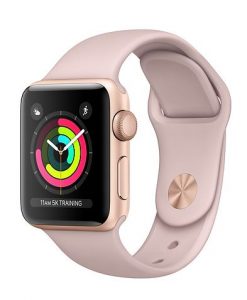
4. Apple Watch Series 3 38mm Smartwatch
Well, the latest in the apple series watch has to appear in any top-10 list. However, it is limited in terms of capability since it is only compatible with iOS. Of course, this would put you off if you are an Android fan. If you are an Apple fan, why not wear a corresponding, yet more attractive smartwatch?

Its features, signature curved design alongside the pink color will most definitely match your love for performance to your sense of fashion. It certainly is better than the predecessor the Apple Watch 2 in most aspects.
The watch connects seamlessly to your iPhone via the watchOS 4.0, to ensure that you never miss any notifications from your apps. Also, you can easily change the face and widgets on the 1.3 Inch display to match your outfit of the day.
As you would expect, this watch has fitness tracking capability. Among the amazing fitness tracking features is the heart rate monitor. It not only tracks your heart beats per minutes but also your pulse when performing any activity.
Apple Watch 3 comes in two versions – one with cellular connectivity while the other has GPS only. Our pick for this review has a combination of both. We have done an extensive research on this amazing gadget and put it in writing. You can read our in-depth Apple Watch 3 review. To save you time, though, here is a summary of the best features that the Apple Watch 3 packs:
Main features
- OLED screen with an Ion-X glass
- Up to 18 hours of battery life
- Bluetooth 4.2, 802.11b/g/n Wi-Fi
- Water resistant up to 50 meters
- Only compatible with iOS via Apple watchOS 4.0
- 38mm case size
- Fitness tracking
Click here to see its current price.
5. Fitbit Charge 2
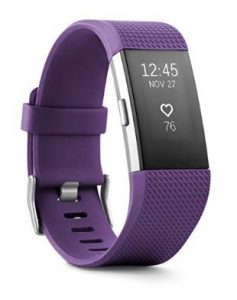
Time is the essence of living, and to live well, you need to keep track of your steps. This is exactly what you will achieve with the Fitbit Charge 2. It is a smartwatch that defies what the others do. It is easy to use, plus it works across different platforms, phones, and even social media networks. If you want an all-in-one kind of smartwatch, then you better go for the Fitbit Charge 2.

The Charge 2 is not only limited to a healthy lifestyle, but it is a great option for all the fitness fanatics. It helps monitor your heart rate to avoid overwhelming your body. All the required stats clearly displayed on the screen. This watch has a big enough OLED display which ensures that you can see your calls, texts and any other notification.
Main features
- Guided breathing sessions
- Smart track
- Long battery life, up to five days
- Reminders to move
- Cardio fitness level
- Call, text and calendar alerts
- Multi-sport tracking and GPS
- Pure pulse heart rate
- Swappable bands
- Compatible with iOS, Android and Windows
Click here to see its current price.
6. Fossil Q Wander Gen 2 Rose Gold-Tone Smartwatch FTW2112
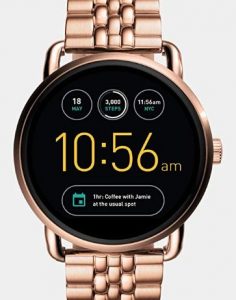
The Fossil Q Wander Gen 2 Stainless Steel smartwatch is one of the watches that stand as a testament to the changing times in the smartwatch industry. It is an accurate indication that the cries for an improvement in design by ladies are being heard. This beautiful piece of technology embraces class and functionality.

First and foremost you get to wear your design. You can choose between the Fossil and the Android look. You can also adjust the colors according to your mood or what you are wearing. The watch face is not the only thing that can boost your sense of style; you can match the straps as well. As if that is not enough, simply touch the screen get to read your notifications. No battle with buttons, just a simple touch will do.
Apart from the sleek design, this watch offers a lot more in terms of fitness tracking. You can automatically sync to your phone and track your steps, distance and calories burned.
Main features
- Music control
- Activity tracking
- Dials and features that can be customized
- Extra straps
- Built-in speaker and microphone
- 24-hour battery life
- Bluetooth 4.1 Low Energy and Wi-Fi 802.11 b/g/n
- Compatible with iOS 9.3+ and Android OS 4.4+ (excluding Go)
- App notifications on the touchscreen
Click here to see its current price.
7. Fossil Gen 3 Q Venture Rose Goldtone Pave Smart Watch
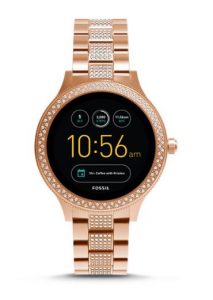
We have seen quite a number of Fossil smartwatches, and this is surely one of their best in terms of design, style as well as functionality. It certainly emulates its predecessor the Gen 2. However, with a goldtone pavé, it has a better outlook in addition to better features.

You get al notifications from your apps on the touchscreen display. These include SMS, emails, calls as well as app update notifications. Also, inbuilt fitness/activity tracking automatically connects to your phone, and helps you keep tabs on steps, distance as well as calories burned.
Despite its already beautiful appearance, you can be able to change the face of the watch using either Fossil or Wear OS. This helps match the watch to your dress code so that you can stand out in any occasion.
Main features
- Compatible with both iOS and Android smartphones
- Fitness tracking
- 24-hour battery life
- Interchangeable straps
- 42mm case size
- Customizable dial
- Weighs 5.28 ounces
Click here to see its current price.
8. Michael Kors Access Touchscreen Bradshaw Smartwatch MKT5004
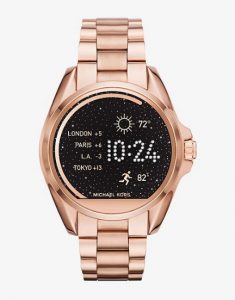
This is a smartwatch that is a clear depiction of how style is starting to dominate the smartwatch industry. Firstly, it comes with several faces so that depending on your mood, you can simply shift to the face that you prefer. This, together with extra straps, give you an upper hand when it comes to customization.

The display here is always on, so there are no black screens to keep you away from your notifications and updates. Everything happens in real time, and nothing passes you by. Also, you can check the weather, surf the net or simply go through your email alerts.
This is a watch for every lady, whether you want one for an event or even for use in the office. If fashion is not your thing but sports is, then you will find a version of this watch for the same function.
Main features
- Display is always on for 24-hour access
- Allows customization with extra straps and watch faces
- 44mm case size
- Compatible with Android OS 4.4+, excluding Go and iOS 9.3+
- Bluetooth 4.1 Low Energy and Wi-Fi 802.11 b/g/n
- 24-hour battery life
Click here to see its current price.
9. Michael Kors Access Women’s MKT5022 – Sofie Connected
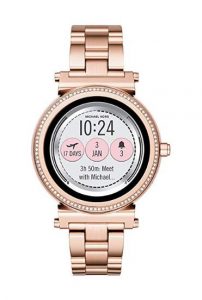
Just one look at this amazing masterpiece and we were hypnotized. Michael Kors has really taken the interest of ladies at heart of late. It easily tops our best smartwatch for women list.
This is a smartwatch that not only gives you amazing features but also ensures that you stand out from the crowd. The style, as well as the finishing, is top-notch. With a bedazzled, circular touchscreen display and a thin strap, it will certainly look beautiful on your wrist.
The rose-gold coated band and case are made of stainless steel, while the bezel is luxuriously pavé-lined.
In terms of functional features, you will not be disappointed. It is powered by Android Wear 2.0 that will keep you connected to all your favorite apps via Android or iOS. So, you are sure never to miss any notifications. For more options when you want to go casual or official, the smartwatch offers the capability of changing the display faces as you like. Also, you can change straps to match your dress code.
Moreover, never be stranded because the Sofie connected ensures that your Google assistant is on hand to help you get through your daily hustle.
Main features
- App notifications
- Bluetooth 4.1 and Wi-Fi 802.11 b/g/n
- Case size 42mm, Strap size 18mm
- 24hrs battery life based on usage
- Compatible with Android 4.4+ and iOS9.3+
- AMOLED display
- 4oz in weight
- Water resistant up to 1 ATM
- Built-in fitness tracking
- Extra buckle for use with interchangeable straps
Click here to see its current price.
If rose-gold is not your cup of tea, there is a similar model in silver. Check it out here.
10. Kate Spade New York Women’s Smartwatch KST2003
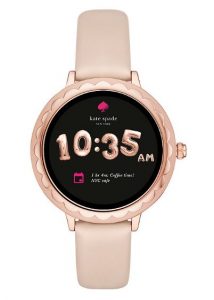
Doesn’t this piece look awesome? Well, that alongside its features had us beat. If you want to take your style to the next level while enjoying most benefits of a smartwatch, this Kate Spade Smartwatch will not disappoint you.

Its unique scallop design and spade detail on the pusher set it apart from the other smartwatches for women. Also, if you are going out, going to work, or attending a function, you can easily match your watch to the day’s outfit using the exclusive ‘choose Your Look’ Watch App.
Powered by Android Wear 2.0, you can get all app notifications on your smartwatch. Life is also much easier thanks to the Voice Activation capability. This lets you connect to Google Assistant and get answers straight from your wrist.
Main features
- Notifications
- 5mm display dial
- Compatible with iOS 9.3+ and Android OS 4.4+ (excluding Go)
- 42mm case size
- Fitness: Custom goal tracking
- 8 ounces in weight
Click here to see its current price.
Why women’s smartwatches are more than just for fashion
A smartwatch should complement your needs. Why are you buying it? If it is for the sake of getting notifications, then you should ensure that the user interface has an excellent display and is user-friendly. For a lady, it has to be stylish. You don’t want something bulky, straight out of Star Trek wrapped around your wrist.
One major feature in all smartwatches is the OS. If you want to buy one, then you should know the type of operating system it uses. This is because an operating system determines the kind of apps that the watch has and the tasks that you can do with it.
Currently, the world is experiencing a revolution in smartwatches. Different companies are innovating and releasing their smartwatch brands into the market, hence the need to know what actually matters. A smart buyer is one who makes a decision after going through relevant information and weighing it against their situation or need.
So, the question is, do you just buy one or do you consider some important factors?
What to Consider When Buying a Lady’s Smartwatch
Do not go into the market blindly. You need to know exactly what a smartwatch is. A smartwatch is an accessory that supplements the service delivery of your phone. This means that your smartphone needs to be connected to your smartwatch and the two will work in sync. You can also go for smartwatches that work with a SIM card.
i. What is the operating system and apps allowed?
The OS is the engine on which your smartwatch operates. Why is the OS important? An OS is what allows connectivity to your smartphone. An iPhone user cannot go for an Android-only smartwatch. However, if you want to go for something that can work with both platforms, then you are welcome to try the Michael Kors brand, among others.
Types of operating systems
When people talk about smartwatches, they assume that they only have two options, iOS, and Android. However, there is a wide array to choose from. The previous two are just more popular, but they are not the only egg in the basket. There is the Pebble and Tizen OS. The Pebble OS is also known as the Watch OS.
Tizen is a product that came as a result of Samsung leaving Android which is a Google platform. The Pebble OS is also an independent operating system, and that is why they have even created exclusive smartwatches for the same. Pebble is the owner of this OS. It uses Kernel, which is an open source. Unfortunately, the Pebble OS developer does not allow other companies to work on this platform.
You should also be aware of the Microsoft smartwatches which use the Windows OS. No need to fret because this OS works well with both Android and iOS. This means that if you need a smartwatch that can work well on any operating system, then a Windows will do well. There are specific watches for iPhone users so as to avoid incompatibility issues.
Android Wear
The Android OS, as stated previously, is one that was developed by Google and they have allowed other companies to access it. Its appearance and interface are attractive. To date, big names like Motorola, Huawei, and LG are still relying on this operating system. It is important to note that Android Wear only works with the Android 4.3 version and above.
Pebble OS
This is an Apple only OS, meaning that it only works with the iPhone. It is still a new kid on the block, but with more than 3500 applications already. The major player in Apple watches is the Siri app which allows you to perform several tasks via speech commands. You are also able to receive and view notifications since you can see widgets on your smartphone.
ii. How is the display?
A few years back, you would look quite weird “talking” to your hand. It was just an imagination that was on display, mostly in spy movies like Bond 007. Nowadays though, with the invention of smartwatches, it has become a bit routine to look at your wrist to check if you have any notifications and so on.
Such a scenario depicts the importance of your smartwatch display. You should be able to read your notifications clearly even when the sun is up. This means that the resolution must be robust enough to withstand the worst weather conditions. That is why you need to know about the technology behind the smartphone you want to buy.
Smartwatch Display Technology
The first in line is the OLED technology. This is also known as AMOLED. There is no need for background light here, due to its high contrast. You may at times find it hard to see what’s on your screen especially in direct sunlight, but at the end of the day, this is one of the best smartwatch displays. AMOLED displays are full of color, unlike OLED which can have a single, two or full colors.
Secondly, there is what is known as an LCD display. These are available everywhere and are cheaper. However, if you want something better, go for a high-quality LCD smartwatch, and you will be good to go.
Everyone wants to have a smartwatch these days, hence the numerous adverts on e-commerce sites. Some smartwatches have E-paper displays. These are actually the cheapest models. This is because they do not consume a lot of power, but then you need to have enough lighting to be able to read the content displayed on your screen.
The color display, which is very common with Apple watches shows you the content which you need to tap. This, of course, consumes a lot of power, and that is why the screen is not always on.
If you are looking for efficient power consumption, Pebble watches are recommended. These smartwatches have the E-Ink display. You can also have your screen on and view it when you need to.
iii. How good is the design?
Design is one aspect that influences ladies’ shopping. The gadget around your wrist is not only an accessory but also a fashion statement. Of course, design is up to an individual’s taste. You need to choose what makes you comfortable. Keep in mind that this is something that you will have to wear every day.
Let’s admit it; most smartwatches are more masculine than feminine. Well, thanks to this realization we are starting to see a trend changing. Smartwatch manufacturers are now going beyond functionality and playing with different shapes, designs, color, materials, and apps.
First, it was all about squares, but now we see circular displays. These smartwatches are gaining popularity with women. That’s not to discourage you from the squares and rectangles if that is your taste.
iv. How long is the battery life?
A smartwatch needs to work smart. It should function optimally without draining too much power. As we have seen initially, the E-Ink displays save on power. No wonder they can keep their charge for up to 5 days.
v. What is the price?
The truth of the matter is that old is gold – what was hot (and may be out of reach) last year is affordable this year. The smartwatch features also matter a lot. The better it is, the more you will need to pay. There are many cheap smartwatches out there, so price should never be a major issue.
vi. Is there anything else?
Surely, you have to get your money’s worth. The watch should afford you some special features. As a woman, you know how to get more for less. Some of the special features that you can look out for are as follows:
- Health monitor – Smartwatches can come with a heart rate sensor, pedometer, and accelerometer. Therefore, you get relevant information regarding your health.
- Music – You can store your music and play it without earphones. You can even control music players on your smartphone.
- An alarm – All watches have alarms, but the ones on smartwatches go an extra mile. They can remind you when you forget your phone. After all, how will it work without its partner?
- Voice command – All you need to do is speak, and a task is as good as done.
- GPS – This is ideal for routing and monitoring calories burnt during exercises or any physical activities.
Don’t just get a smartwatch just because it is the in-thing to have. Ensure that you need it. Ask yourself the following:
- Do I like the design?
- Can my smartphone perform well with the given OS?
- Is it waterproof?
- Does it maintain its charge for longer?
- What apps does it support?
- Does it come with other useful special features?
So, why are women not wearing smartwatches?
According to a consumer report that released in 2015, 71% of smartwatch users were male. This begs the question: Why are women not using these gadgets?
i. Poor design
Granted, there are various designs, but the available options are limited. From the colors to the shapes, most are not petite enough for the soft wrist. In this era of color clashing, women want something that defies the norm. They want brightly colored straps and a display shape that is not so huge.
Is this a hopeless situation? Actually no. Enough noise has been made, and smartwatch manufacturers are starting to change their ways. Huawei, among other tech companies, has introduced a new line of smartwatches for the ladies. We are talking about faux crocodile leather and Swarovski Zirconia crystals.
ii. Unfriendly size
Most women do not like gigantic accessories. Image is everything to a lady, and she doesn’t want the attention focusing solely on her arms. A watch should complement her dressing, not overshadow it.
iii. There is stereotyping
Who said that a pink smartwatch was too girly? Clearly, smartwatch manufacturers are not listening to their customers. It is time to mix and match so that everyone gets what they want. Reduce the strap size or even make it thinner and see if women will not wear smartwatches.
iv. Women don’t need smartwatches
This is like saying women don’t need Wi-Fi. It is insane. Unfortunately, the marketers are failing. They actually need to sell its functions. Most marketers assume that women do not want to buy smartwatches and this leaves them in the dark. People make purchases out of informed choices.
The evident truth is that the smartwatch manufacturers have been making big, bulky watches and being quite oblivious when it comes to who will wear their products.
Conclusion
There are many smartwatches that women can choose from. It all depends on the primary use and design. Simply go for something that delivers and one that you can also afford without breaking the bank. Technology is changing the face of everything as we know it. Time is not excluded from this list, why stick to telling time when you can go beyond? Everything we do is dictated by the time available.
Our pick as the best smartwatch for women is the Garmin vívomove HR Sport Hybrid Smartwatch.
It is not about working hard but working smart. Image is paramount, so get a smartwatch that does not only meet your needs but also matches your taste and go ahead and join the smart world movement. Now, it’s up to you to select among our best smartwatch for women collection.
We have also listed the best smartwatches for men in a separate smartwatch review.
In summary, these are the 10 best smartwatches for women to buy in 2026:
- Garmin vívomove HR Sport Hybrid Smartwatch – Rose Gold
- Withings Activité Pop
- Samsung Gear S3 Classic Smartwatch
- Apple Watch Series 3 38mm Smartwatch
- Fitbit Charge 2
- Fossil Q Wander Gen 2 Rose Gold-Tone Smartwatch FTW2112
- Fossil Gen 3 Q Venture Rose Goldtone Pave Smart Watch
- Michael Kors Access Touchscreen Bradshaw Smartwatch
- Michael Kors Access Women’s MKT5022 – Sofie Connected
- Kate Spade New York Women’s Smartwatch KST2003
If you have any comment or you need any clarification, feel free to let us know in the comments section.